Chewable Tablet Manufacturing: The Complete Guide
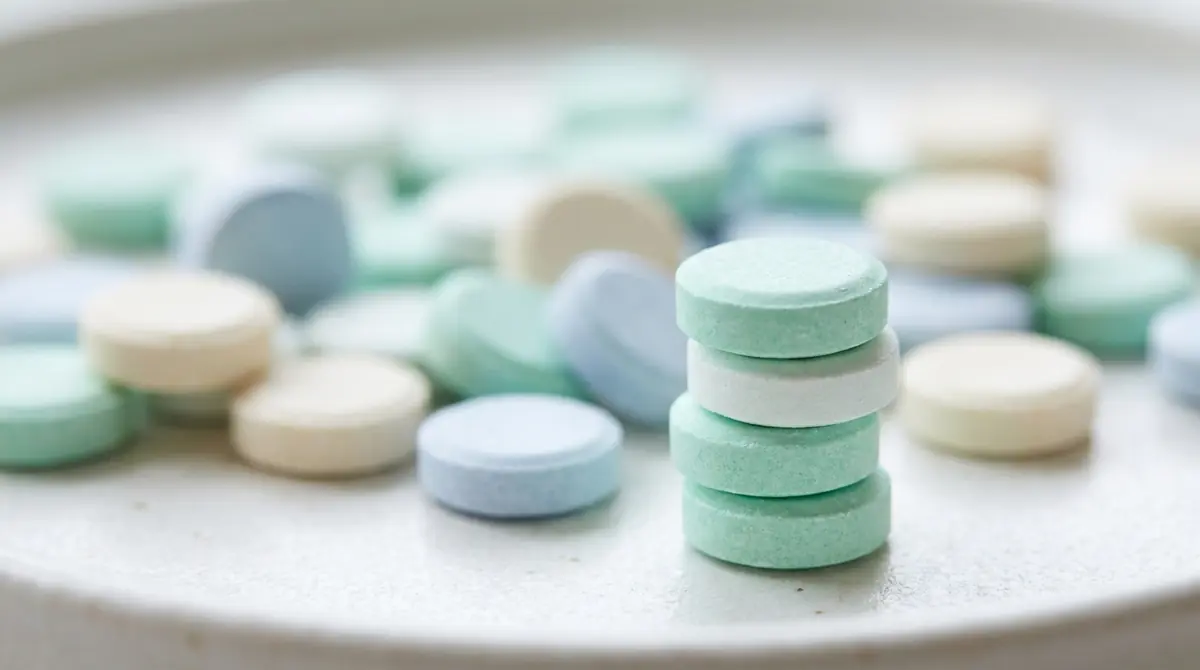
Chewable tablets are compressed tablets made to be chewed instead of swallowed whole. Manufacturing them is closer to conventional tablet pressing than to gummy making: powders are blended, sometimes granulated, then pressed into a tablet firm enough to survive a bottle and soft enough to break apart between teeth. That single difference in process explains most of what the format does well. Compression runs dry and at room temperature, so a chewable can carry doses and ingredients that a cooked gummy slurry cannot.
This guide is for brand founders weighing chewables against gummies and capsules and then trying to pick a manufacturer. It covers what the format is, how the tablets are made, which actives fit, what Canadian and US regulations require, and what a first production run costs. Nutricraft Labs coordinates chewable tablet manufacturing through GMP-certified partner facilities, with runs starting at 1,000 units per SKU. The numbers in this guide are the same ones we quote clients.
What counts as a chewable tablet
A chewable tablet is a solid dose made by compressing a powder blend under pressure, formulated to break down through chewing rather than swallowing. The chew starts disintegration in the mouth, which removes the swallowing barrier that keeps many people, children especially, away from conventional pills.
Three things separate a chewable from a swallowed tablet. It is usually wider, since it never has to go down whole. It is pressed softer, so teeth can break it apart without effort. And a meaningful share of the formula goes to sweeteners, flavors, and mouthfeel agents, because the entire tablet gets tasted.
A chewable is not a gummy. Gummies are confections: a gelatin or pectin slurry is cooked, deposited into molds, and cured, which is candy manufacturing with actives added. Chewables come off a tablet press. That sounds like a production detail until you compare active loads, stability, and sugar content, where the two formats part ways quickly.
The category covers a wide range of products, from children’s multivitamins and large calcium tablets to tart vitamin C rounds and small cherry-flavored B12 tablets. If you want the consumer-facing case for the format, our chewable tablets page covers benefits, texture, and typical applications. This guide stays on the manufacturing and buying side.
Chewables vs gummies vs capsules
Most founders arrive at this decision with a gummy in mind, because gummies dominate retail shelves and feel like the safe consumer pick. Each format wins somewhere, though, and the deciding factors are usually dose size, ingredient sensitivity, sugar tolerance, and budget.
Chewables carry more active per unit than gummies, hold up better in storage, and bring far less sugar along for the ride. Gummies beat everything on taste and shelf appeal; for a product that has to feel like a treat, nothing else is close. Capsules are the cheapest way to deliver bitter or high-dose actives, since the shell hides taste completely and the fill needs no sweetener system at all.
Here is how the three formats compare on the factors buyers ask about most:
| Chewable tablets | Gummies | Capsules | |
|---|---|---|---|
| Active load | High. Gram-level minerals are workable in one or two tablets | Low. Suited to small doses; large doses take many gummies | High. Limited by capsule size and count per serving |
| Sugar content | Low, and sugar-free versions are routine | Highest of the three, even in reduced-sugar recipes | None |
| Stability and shelf life | Strong. A dry matrix protects sensitive actives | Weakest. Moisture in the matrix works against sensitive actives | Strong. Dry fill inside a sealed shell |
| Dosage accuracy | Tight. Compression controls tablet weight precisely | Looser. Cooking and depositing introduce more variation | Tight |
| MOQ and cost | Moderate. Nutricraft coordinates runs from 1,000 units | Often higher. Depositing lines favor bigger batches | Lowest cost per dose for bitter or high-dose actives |
| Consumer appeal | Good. Pleasant to take without reading as candy | Strongest. Looks and tastes like a treat | Weakest. Functional rather than enjoyable |
A few notes on reading that table. The active load gap is structural: a gummy matrix is mostly gelling agent, water, and sweetener, so the active has to fit into whatever room is left, while a compressed tablet is mostly whatever you press into it. Stability follows the same logic. A gummy holds moisture by design, and moisture is what degrades many sensitive actives; a chewable is a dry system from blend to bottle. Sugar runs the other way. Gummies need sugars or sugar substitutes to be gummies at all, while a chewable can be sweetened lightly and still taste good.
Cost is more even than most founders expect. Per-unit pricing depends on the active deck, run size, and packaging more than on the format itself. Where the formats separate is at the extremes: capsules are hard to beat for a bitter botanical at a high dose, and gummies get expensive per milligram of active as doses climb, because you are paying for candy mass around a small payload.
If your product genuinely lives on taste and the dose is small, a gummy may be the right call, and our gummies page covers when that format earns its place. If the dose is large, the active is sensitive, or the sugar line on the label matters to your buyer, a chewable will usually serve the product better.
How chewable tablets are made
A chewable run moves through the same broad stages as any compressed tablet. Incoming raw materials are identity-tested and held until they pass. Powders are blended, the blend is pressed, and finished tablets are inspected, bottled, and sealed. The decisions that make or break a chewable happen inside blending and compression, and in the flavor work that runs alongside them.
Direct compression or wet granulation
Direct compression is the simpler route. Actives are blended with compression-friendly excipients and pressed straight into tablets. There is no added water and no drying step, which keeps cost down and, more important for many formulas, keeps heat and moisture away from sensitive ingredients. The tradeoff is that the blend has to flow and compress well on its own, which is why direct-compression formulas lean on excipient grades built for the job.
Wet granulation adds steps. A liquid binder is worked into the powders, the wet mass is dried and sized into granules, and the granules go to the press. Granulation earns its cost when the blend will not cooperate: fluffy powders that refuse to flow, dusty actives that would separate in the hopper, or a potent low-dose ingredient that needs locking into granules so every tablet gets its share. The added heat and moisture rule it out for some sensitive actives, so the routing decision is made formula by formula.
Taste masking
Chewing exposes the whole dose to the tongue, so taste has to be engineered from the first prototype. Formulators mask difficult actives in several ways. Coating the active particles in a thin lipid or cellulose layer keeps them off the taste buds until after the chew. Choosing a milder salt form of the same nutrient cuts bitterness at the source. Acid adjustment with citric or malic acid brightens flavor and covers metallic notes. Granulating a harsh active buries the fine particles that hit the tongue hardest. Most commercial formulas use two or three of these together, tuned across several taste rounds.
Sweetener systems
Sucrose and dextrose are the classic base: inexpensive, clean-tasting, and easy to compress. Their drawback shows up on the label, and since sugar content is one of the main reasons founders move away from gummies in the first place, most modern chewable briefs start from a reduced-sugar or sugar-free position.
Polyols are the standard sugar-free answer. Sorbitol and mannitol compress well and give a smooth, slightly cooling mouthfeel that suits mint and fruit flavors. Xylitol chews pleasantly and sweetens close to sugar. Polyols do have a ceiling: at high daily intakes they can cause digestive upset, which caps how much fits in a serving and sometimes puts a note on the label.
High-intensity sweeteners close the remaining gap. Stevia is the common natural choice, nearly always blended over a polyol base, because on its own at higher levels it can leave a bitter, licorice-like aftertaste. Balancing a polyol base, a stevia top note, and an acid system against the off-notes of the actives is bench work, and it takes taste panels rather than theory to finish.
Flavor and mouthfeel
Flavor in a chewable runs through the whole tablet rather than sitting on the surface, so it has to survive compression and stay stable next to the actives for the life of the product. Citrus, berry, and vanilla carry most of the market because they pair naturally with lightly sweet polyol bases and cover mineral notes well.
Mouthfeel is the quieter half of the job. A good chewable breaks down into a smooth paste as it is chewed. Particle size does most of that work: actives milled too coarse feel sandy, and some minerals read chalky at high loads no matter what, which is where mouthfeel agents and careful excipient choices earn their space in the formula.
Hardness and friability
A chewable lives in a narrow mechanical window. Pressed too hard, it hurts to chew, and children and older adults notice first. Pressed too soft, it chips in the bottle, dusts during shipping, and arrives broken. Manufacturers steer between the two with compression force and binder levels, then verify with hardness checks and friability testing, where sample tablets tumble in a drum and are weighed afterward for edge wear. Targets are set per product rather than pulled from a universal chart, since a large adult calcium tablet can run firmer than a small tablet meant for a six-year-old.
Which actives work well in chewables
The format has a natural shortlist, and it maps to what compression does well: large doses, sensitive ingredients, and small doses that leave the formula plenty of room for taste.
Children’s multivitamins are the anchor application. Parents want meaningful doses with less sugar than gummies deliver, and children accept a pleasant tablet they can chew. Dosing precision also matters more in children’s products than anywhere else, and compression delivers it.
Vitamin C has sold as a chewable for decades and remains one of the easiest actives in the format. Ascorbic acid is tart rather than bitter, so the flavor system can work with it instead of against it, and citrus flavors turn the sourness into part of the appeal.
Calcium is where chewables pull away from every other consumer-friendly format. Calcium carbonate, the same ingredient commonly used in antacid-style calcium products, calls for doses far beyond what a gummy matrix can hold. One or two chewable tablets carry what would otherwise take a handful of gummies, at a fraction of the sugar.
Vitamin B12 sits at the other end of the dose spectrum. The active occupies almost none of the tablet, so nearly the entire formula is available for a good-tasting base. Small cherry-flavored B12 chewables are a category staple for exactly that reason.
Magnesium is workable but takes real formulation skill. Doses are large, and the common forms carry metallic and bitter notes, so the product usually ends up as a bigger tablet or a two-tablet serving, with serious masking work either way. It is a good chewable candidate when your buyers resist capsules; otherwise a capsule is often the calmer path for this mineral.
The less obvious winners are heat- and moisture-sensitive actives. Gummy production cooks a slurry hot and keeps it moist through depositing and curing, which is rough on probiotics, enzymes, and certain vitamins. Compression happens dry at room temperature. Actives that would fade during gummy processing routinely come off a tablet press in good shape, and a brand that watches a sensitive active fall in gummy stability testing often reformulates the product as a chewable on the next run.
Formulation challenges
Bitter actives are the first wall. Zinc, magnesium, iron, B vitamins, and many botanical extracts taste bad in ways sweetness alone cannot cover. The masking toolkit handles most of them, but every fix spends formula space, and past a certain point a capsule is the more sensible home for the ingredient. Part of a good manufacturer’s job is telling you when that point has been reached rather than pushing the format anyway.
Hygroscopic ingredients, the ones that pull moisture from the air, are the second. Certain mineral salts and botanical extracts soften tablets over shelf life, stick to press tooling during the run, and shorten stability. The fixes live in process and packaging: drier processing conditions, coated raw materials, granulation, desiccants in the bottle, and sometimes a switch to a less moisture-hungry form of the same nutrient.
Dose uniformity gets harder as the active load climbs. In a tablet that is mostly active, little excipient remains to manage flow, compression, and taste, and those three start competing for the same few milligrams of space. High-load formulas take more development rounds, and in-process blend uniformity checks matter more, because a weak zone in the blend becomes an under-dosed tablet.
None of this is exotic. These are the standard reasons a chewable takes longer to develop than a capsule, and they are why our custom formulation service budgets time for bench trials and taste rounds instead of assuming a first-pass formula will hold.
Regulatory notes for Canada and the US
Canada regulates supplements as natural health products, and the rule that matters most is timing: the product needs a Natural Product Number, an NPN, from Health Canada before it can be sold. Review time depends on the application class. Class I applications, which fit entirely within existing Health Canada monographs, carry a 60-day service target. Class III applications, which rely on evidence outside the monographs, can run 210 days or more. A chewable built on well-established monograph ingredients usually lands in the faster lanes, which is worth knowing before you commit to a novel ingredient deck.
Canadian labels must present required information in both English and French. Plan the bilingual layout early: French text runs longer than English, chewable bottles are often small, and a label designed English-first tends to need a second design pass once the French is added.
The US takes the opposite approach to market entry. Dietary supplements have no pre-market approval step; under DSHEA, the FDA regulates them once they are on the market, and responsibility for safety and truthful labeling sits with the brand. Products carry a Supplement Facts panel, and manufacturing facilities register with the FDA. The US partner facility Nutricraft coordinates with is FDA-registered.
Two practical notes for a launch plan. Some brands open US sales while their Canadian NPN application is in the queue, since only the Canadian side gates the market before launch. And claims discipline applies in both countries: labels and marketing can describe a nutrient’s role in normal body function within each country’s permitted wording, and disease treatment claims are excluded in both.
MOQ, cost, and timelines
Nutricraft’s minimum order is 1,000 units per SKU, deliberately low for this category. Chewable projects at large manufacturers often start at volumes a first-time brand cannot responsibly commit to, and closing that gap is the point of our low-MOQ manufacturing service.
White label is the fast path. You choose an existing chewable formula, apply your brand, and reach market in 4 to 6 weeks. A first white label run costs $8,000 to $12,000, with projects starting from $8,000.
Custom formulation runs 12 to 16 weeks from concept to market and costs $15,000 to $25,000 all-in, covering the work between idea and sellable product: formula development, flavor and mouthfeel rounds, compliance review, and the first production run. Chewables tend to sit toward the longer end of a development window compared with capsules, because taste rounds add iterations that a swallowed format never needs.
For Canadian retail, put the NPN clock beside the manufacturing clock. A Class I application’s 60-day target can overlap neatly with a custom development timeline. A Class III application may finish well after the product is otherwise ready, and it is better to learn that in week one than in week twelve.
How to choose a chewable manufacturer
Chewables punish inexperience more than capsules do, because taste and texture failures only show up when a person chews the finished product. When you evaluate manufacturers, or a coordinator like Nutricraft that matches you with one, work through a short list:
- Confirm GMP certification and ask how recently the facility passed an audit.
- Ask about chewable experience specifically. Many facilities press tablets; fewer have deep practice with flavor systems and large-format chewable tooling.
- Ask how many flavor rounds the quote includes and who evaluates them.
- Ask how hardness and friability targets are set for your product and how they are checked during the run.
- Ask what regulatory support is included, especially NPN applications and bilingual labels for Canada.
- Check that the minimum order matches a sensible first run for your brand rather than the factory’s preferred batch size.
The answers tell you more than a brochure will. A partner who can walk you through their taste panel process and their plan for a hygroscopic active has done this before. A partner who quotes a price without asking about your active deck has not.
Nutricraft’s role in this picture is coordination. We match your product to a GMP-certified partner facility that runs the format well, and we manage formulation, quoting, regulatory work, and production scheduling through one contact. For format details like typical doses, textures, and applications, the chewables page is the quick reference.
Frequently asked questions
What is the minimum order for chewable tablet manufacturing?
Through Nutricraft, 1,000 units per SKU. That floor is low enough for a genuine market test: a first white label run costs $8,000 to $12,000, so a founder can put a chewable in front of real customers without committing to warehouse-scale volume.
How long does it take to launch a chewable tablet product?
White label projects take 4 to 6 weeks from order to finished goods. Custom formulations take 12 to 16 weeks from concept to market, with the extra time going into formula development and taste rounds. For Canadian sales, add the NPN application to the plan: Class I applications carry a 60-day service target, and Class III applications can take 210 days or more.
Are chewable tablets better than gummies?
For large doses, sensitive actives, and lower sugar, yes. For pure consumer appeal, gummies still win, and a taste-first product with a small dose is often right as a gummy. Brands that run both formats usually split them by dose: calcium and the daily multivitamin go chewable, and the low-dose lifestyle product goes gummy.
Can chewable tablets be made sugar-free?
Yes, and it is routine. Polyol sweeteners such as sorbitol, mannitol, and xylitol replace sugar as the tablet base, with stevia adding intensity on top. The main care point is polyol tolerance: high daily intakes can cause digestive upset, which caps the serving size and occasionally adds a label note.
Can heat-sensitive ingredients like probiotics go into a chewable?
Often, yes, and it is one of the format’s quiet advantages. Compression is a dry, room-temperature process, so it spares actives that hot, moist gummy processing degrades. Each strain or enzyme still needs its own stability assessment in the finished tablet, which is a normal part of development.
Do I need an NPN to sell chewable tablets in Canada?
Yes. Every natural health product sold in Canada needs a Natural Product Number from Health Canada before sale, and the label must carry required information in English and French. Chewables built on monograph ingredients typically qualify for lower application classes with shorter review targets.
If you are deciding between a chewable, a gummy, and a capsule, the fastest route to a real answer is a short conversation about your dose, your actives, and your budget. Contact Nutricraft and we will tell you whether a chewable fits your product and what a first run would cost.
Ready to Start Your Supplement Brand?
Let's discuss how we can help bring your vision to life with our comprehensive manufacturing services.
Related Articles
2026 Private Label & Contract Manufacturing Shifts: Low MOQ, GMP, and Speed to Market
How supplement founders can balance low MOQs, GMP certification, and faster launches in 2026's shifting contract manufacturing landscape.
Read more →The 2026 Private Label Playbook: Low MOQ, Fast Turnaround, and Regulatory Navigation
A practical 2026 roadmap for first-time supplement founders: low MOQ private label, NPN and FDA compliance, and one point of contact from formula to shelf.
Read more →2026 Supplement Trends: What's Growing, What's Shifting, and How to Formulate for It
A practical look at 2026 supplement trends: what's rising, what's consolidating, and how to formulate SKUs that meet NPN and FDA requirements.
Read more →