How to Choose a Supplement Contract Manufacturer in Canada
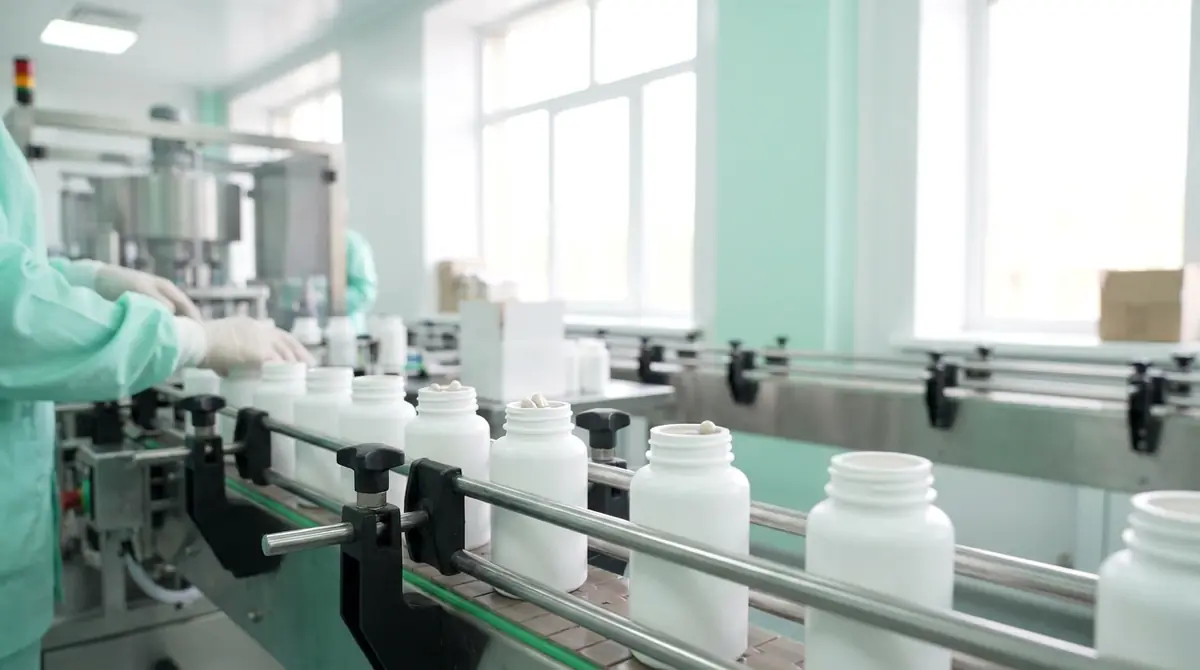
Search for Canadian supplement manufacturers and the results all look alike. Every site has a GMP badge, a photo of a capsule filling line, and a quote form. Behind those near-identical pages the range is enormous. Some are licensed facilities with clean audit histories. Others are sales offices reselling capacity they have never inspected, and from the outside it is genuinely hard to tell which is which.
This guide is the vetting process we would want any founder to run, including on us. The short version first. Six things matter more than everything else combined:
- A Canadian manufacturer, packager, or labeller must hold a Health Canada site licence, and you should verify the number instead of trusting the badge on the website.
- Real NPN experience is the difference between launching on schedule and spending six extra months learning Health Canada’s process at your own expense.
- Testing questions come before price questions: what gets tested, at which lab, on every batch or on a sampling schedule.
- The right minimum order quantity depends on your stage, and a 20-30% per-unit premium for a 1,000-unit first run is often money well spent.
- Factory-direct and coordinator models both work, for different kinds of founders, and you should know which one you are buying.
- Lead times and payment terms reveal how organized an operation is before you ever see a facility.
The rest of this article works through each of these, then covers the questions to ask on a first call, the red flags that should end a conversation, and a checklist you can copy into your notes.
Start with the licences
Most supplements sold in Canada are natural health products under the Natural Health Products Regulations: vitamins, minerals, herbal products, probiotics, amino acids, and most sports nutrition. Any company that manufactures, packages, or labels these products for sale in Canada must hold a site licence issued by Health Canada’s Natural and Non-prescription Health Products Directorate. Importers of finished product need one too. The licence is granted against evidence of GMP compliance, and it lists exactly which activities and which dosage form classes the site is approved for.
That last detail matters. A site licensed only for packaging and labelling cannot legally manufacture your capsules. When someone says “we’re licensed,” the follow-up question is what the licence covers.
Verifying is straightforward. Ask for the site licence number. A legitimate operation will give it to you in the first conversation, sometimes before you ask. With the number in hand, ask to see the licence document itself, check the listed activities and dosage forms against your product, and confirm directly with Health Canada that the licence is active. Hesitation at this step is information.
Two cautions. A framed GMP certificate is not a site licence. Private certification bodies vary widely in rigour, and some will certify nearly anyone who pays; the Health Canada site licence is the credential that matters for Canadian production because the regulator issues it and can pull it. Second, “GMP certified” claims about facilities in other countries need their own verification, because the phrase has no single meaning across borders.
For the US market the framework is different. The FDA does not license supplement manufacturers. Facilities register with the FDA as food facilities and must comply with the cGMP rules in 21 CFR Part 111, which the FDA inspects against. Registration is not approval. It takes an afternoon to complete and proves very little on its own, so ask for the registration number and then ask for something stronger: the facility’s most recent third-party cGMP audit report, or certification from an established program.
If you are weighing where your product should be made, licensing is a large part of that decision, and we cover it in more depth in our guide to supplement manufacturing in Canada.
Check real NPN experience
Every natural health product sold in Canada needs its own product licence before it goes on sale, and the eight-digit Natural Product Number on the label is the proof. There is no sell-first, license-later path in Canada. A product without an NPN cannot legally be sold.
This is where manufacturers differ more than anywhere else. The application process runs through Health Canada, and the difficulty depends on your formula. Products that fit an existing Health Canada monograph move through Class I or Class II review, with service standards of roughly 60 and 90 days. Novel combinations, or ingredients without monograph support, fall into Class III, where the standard is 210 days and the evidence requirements are much heavier. A partner who has carried dozens of products through this process knows before you sign which class your formula lands in, which claims the monographs support, and which single ingredient is about to cost you four months. One who has not will find out at your expense.
Verification is easy, and almost nobody does it. Granted NPNs are public. Ask for the NPN numbers of products the company has made or licensed, then look them up in Health Canada’s Licensed Natural Health Products Database, which anyone can search. You will see the licence holder, the dosage form, the ingredients, and the approved claims. A company with no NPNs to point to has not manufactured for the Canadian market, whatever its website says.
One more question worth asking early: whose name goes on the product licence? Some manufacturers file the NPN under their own name, which means they hold your product licence, and switching manufacturers later becomes complicated. Filing in your company’s name keeps the asset yours. Our NPN application service walks through how the process works and what evidence Health Canada expects.
Ask about testing before you ask about price
Price differences between quotes usually trace back to testing and ingredient sourcing, so testing is the first quality conversation worth having.
Four test categories cover most of the risk on a finished supplement: identity (is the ingredient what the label says), potency (is the dose in the capsule), microbial (bacteria, yeast, mould), and heavy metals (lead, arsenic, cadmium, mercury). Ask which of the four run on your finished product, at which lab, and how often.
“At which lab” matters because in-house results and independent results are different kinds of evidence. In-house testing is good process control. Independent confirmation should come from a lab accredited to ISO 17025, the international standard for testing laboratory competence. Accreditation scopes are public, so once a manufacturer names its lab you can check whether that lab is accredited for the specific tests in question.
“How often” is the per-batch versus skip-lot question. Skip-lot testing means testing some lots and inferring the rest from supplier history. It is a legitimate, standard practice for low-risk attributes once a supplier relationship has years of clean data behind it. It is the wrong answer for finished-product potency at the start of a new relationship. A good answer sounds specific: identity on every incoming raw material lot, a full finished-product panel on every batch, heavy metals on a skip-lot schedule for two ingredients with a documented history. A bad answer is “we test everything,” delivered quickly, with no paperwork behind it.
Then ask for the paperwork. A certificate of analysis from a recent production lot, with the client’s details blanked out, is a normal thing to request and a normal thing to provide. Check that the COA reports results against specifications rather than a bare “pass,” and that the lab named on it matches the lab you were told about. Our quality and testing page lists what we require from partner facilities on every run.
Match the MOQ to your stage
Standard custom-manufacturing minimums in this industry run 5,000 to 10,000 units. Low-MOQ programs starting around 1,000 units exist and have become more common, usually at a per-unit premium of 20 to 30% over the same product at standard volume.
The premium is real cost rather than a markup trick. A production run carries fixed costs: line changeover and cleaning, batch records, setup, and per-run testing cost roughly the same whether the run is 1,000 units or 10,000. Raw materials bought in small quantities also price worse. Spread those fixed costs over fewer bottles and each bottle carries more of them.
Whether the premium is worth paying is a cash-flow question. Say a capsule product costs $4.00 per unit at 10,000 units and $5.00 at 1,000. The big run ties up $40,000 in inventory before you have validated the product. The small run ties up $5,000, and the premium cost you $1,000. If the product sells, you reorder at better pricing having lost very little. If it does not sell, the $35,000 you never spent is still in the company, and for a first-time founder that difference is often the company. Expiry dating cuts the same way: a 10,000-unit bet you cannot move before the expiry date becomes a write-off.
Going straight to standard volume makes sense when the risk is already priced out: a proven SKU expanding into a second market, committed retail purchase orders, an existing subscriber base. Until then, small runs are the cheaper way to be wrong. Details on how we structure this are on our low-MOQ manufacturing page.
Factory-direct vs coordinator: which model fits you
There are two ways to buy contract manufacturing, and many founders don’t realize they are choosing between them.
Factory-direct means you contract with the facility that physically runs your product. Coordinator means you contract with one company that manages the project across facilities it has qualified, bundling formulation, regulatory work, labels, and production under one agreement. Nutricraft Labs is a coordinator: we manage formulation, NPN licensing, labelling, and production through GMP-certified partner facilities in Canada, the US, and China, and we do not run the filling lines ourselves.
Both models work. They fit different situations, and each carries real costs the other does not.
Buying direct can mean a lower per-unit price at scale, since there is no coordination layer in the middle, and it gives you a first-hand relationship with the people making your product. The cost is that you become the project manager. Formulation, the NPN application, label compliance, packaging procurement, and lot testing become separate vendor relationships you find, contract, and reconcile yourself, and the factory will run whatever spec you hand it. Factories also rarely turn work away: a facility built around capsules will quote your gummy project anyway, and you have no easy way to know the line is a poor fit until stability problems appear a year in. If you have operations experience, your own regulatory support, and volume, direct is often the right call.
A coordinator inverts those tradeoffs. You get one contact and one contract covering the whole chain, and because a coordinator works across several facilities, your product can be placed on the line best suited to its format instead of the line a salesperson happens to represent. You pay for that in the unit price, and you give up choosing the factory yourself.
Which raises the question founders ask most: which factory will make my product? Most coordinators, us included, will not name the facility upfront, and it is fair to want to know why. Two reasons. The qualified-facility network and its negotiated pricing are the core of what a coordinator sells, and the factory’s name is the one piece of information that lets a client take the finished spec and go direct, so it stays confidential until an agreement is in place. The facilities themselves also require it, because they run production for many brands that compete with one another and do not want their client lists public. What you can reasonably expect instead: the country your product will run in, the site’s licence and certification status with numbers you can verify, audit documentation under NDA, and a lot-specific COA with every run. The Canadian partner sites we work with hold Health Canada site licences, and the US partner facility holds its own FDA registration; those credentials belong to the facilities, and we hand over the numbers for verification once an agreement is signed. A coordinator unwilling to provide even that much has answered your real question. Our GMP partner matching page describes how we qualify facilities and what documentation clients receive.
The questions to ask on your first call
Take this list into the first conversation. The pattern in the answers matters as much as the content: good operations answer with specifics and paperwork, weak ones answer with adjectives.
- Who holds the site licence for the facility that will run my product, and what is the licence number?
- Which activities and dosage forms does that licence cover?
- For US-market production, is the facility FDA-registered, and when was its last third-party cGMP audit?
- How many NPN applications have you supported in the past two years, and can you share numbers I can look up?
- Whose name will be on my product licence?
- Which ISO 17025-accredited lab tests your finished product, and can I see a recent COA?
- Which tests run on every batch, and which run on a skip-lot schedule?
- What is the MOQ for my format, and what is the per-unit price at 1,000 units versus 5,000?
- If we develop a custom formula together, who owns it?
- What are current lead times for white label and for custom work, and when did a run last miss its date?
- What does a production sample cost, and is it credited against my first order?
- What are your payment terms on a first order?
Question 9 deserves special attention, because formula ownership hides in contracts. If the manufacturer owns the formula you paid to develop, you cannot take it anywhere else, and your reorder pricing will reflect that.
The vetting checklist
| Criterion | What good looks like | How to verify |
|---|---|---|
| Canadian site licence | Active licence covering the activities and dosage forms your product needs | Ask for the number, review the licence document, confirm status with Health Canada |
| US facility status | FDA food facility registration plus a recent third-party cGMP audit against 21 CFR Part 111 | Registration number plus the audit report or certification letter |
| NPN track record | Multiple granted NPNs in your product category, filed in clients’ names | Look the numbers up in the Licensed Natural Health Products Database |
| Testing | Identity, potency, microbial, and heavy metals on finished product at an ISO 17025-accredited lab | Request a recent COA and check the lab’s accreditation scope |
| MOQ fit | A program matched to your stage, quoted at two volumes so you can see the price curve | Compare per-unit pricing at 1,000 and 5,000 units |
| Samples | Paid production samples, around $500, credited to the first order | Order one before signing anything |
| Lead times | Written estimates: 4-6 weeks white label, 12-16 weeks custom | Dates in the quote, plus an honest answer about the last delay |
| Payment terms | 50% deposit, balance before shipment, on a real contract | The quote and contract themselves |
Red flags
Any one of these is a reason to slow down. Two or more is a reason to walk away.
- The site licence number never materializes. You hear “we’re fully GMP certified” repeatedly, but the specific number, which takes ten seconds to provide, keeps not arriving.
- No independent testing. Everything is tested “in-house,” no COA is available, or the COA carries no lab name.
- Pricing far below market. If four quotes cluster around $4.50 a unit and one comes in at $2.40, the missing $2 came from somewhere, and it is usually ingredient quality, overages, or testing.
- Zero Canadian track record paired with big Canadian promises. A manufacturer with no NPNs who tells you Health Canada licensing is quick and easy is describing a process they have never been through. Class III reviews run up to 210 days.
- Refusal to provide samples, or only stock samples that tell you nothing about how your own formula will be handled.
- Lead times that stay vague. “It depends” is an honest first answer; refusing to put a date range in a written quote is a different thing.
- Pressure to skip compliance. “You can start selling while the NPN is pending” and “nobody really checks labels” are invitations to build your brand on a violation. Health Canada publishes its enforcement actions, and retailers check for NPNs before stocking product.
How lead times and payment terms usually work
For white label production, where you put your brand on an existing licensed formula, 4 to 6 weeks from confirmed order to finished goods is normal. Custom formulation runs 12 to 16 weeks, and the calendar fills with things founders rarely anticipate: formulation rounds, raw material sourcing, packaging lead times, pilot batches. The NPN application runs on its own clock in parallel, and for a Class III product it can be the longest item on the whole schedule. Print labels only after the number is granted, because the NPN has to appear on the label.
Payment terms for a new client are usually a 50% deposit on order confirmation and 50% before shipment. This structure protects both sides: the deposit covers raw materials the manufacturer buys for your run, and paying the balance only at pre-shipment means you still have recourse if the goods arrive wrong. Net-30 terms come later, after order history. A brand-new supplier offering generous credit upfront is more unusual than reassuring.
Paid samples are a good sign, oddly enough. A true production sample of your formula costs real money to make, and a manufacturer charging around $500 for one, credited against your first order, is showing you that samples go through an actual production process. Free samples usually mean stock product from someone else’s run, which tells you what someone else’s product tastes like.
Frequently asked questions
Do I need my own licences to sell supplements in Canada?
You need a product licence, the NPN, for every product you sell, and it can be issued in your company’s name without you owning any facility. A site licence is only required if you manufacture, package, or label products yourself, or if you import finished goods from outside Canada as the importer of record. If a licensed Canadian facility handles production, or importation is structured through a licensed importer, your business does not need to hold a site licence itself.
How long does an NPN application take?
Health Canada’s service standards are roughly 60 days for Class I applications (formulas fully within an existing monograph), 90 days for Class II, and up to 210 days for Class III, which covers novel ingredients and combinations without monograph support. The class depends on the formula, which is a strong reason to settle the formula before building a launch date around it.
Can a factory outside Canada make products for the Canadian market?
Yes. The product still needs an NPN, the foreign site must meet Canadian GMP evidence requirements, and the Canadian importer of record needs a site licence that covers the foreign site. US and Chinese facilities produce for the Canadian market routinely; the paperwork chain just has more links, and someone has to own each one.
What does a 1,000-unit first run usually cost?
For a capsule product, per-unit pricing at 1,000 units commonly lands between $4 and $8 depending on the formula, so $4,000 to $8,000 for the run itself. One-time costs sit on top of that: formulation work, the NPN application, label design and compliance review typically add a few thousand dollars. A typical first launch lands somewhere between $8,000 and $15,000 all-in, with premium formulas above that.
What is the difference between white label and private label?
White label means putting your brand on a manufacturer’s existing, already-licensed formula, which is the fastest and cheapest route to market. Private label generally means a formula customized or built for your brand. The industry uses both terms loosely, so ask each company what it means by them before comparing quotes.
Verify, then decide
Choosing a supplement contract manufacturer in Canada comes down to verification: licence numbers you check, NPNs you look up, COAs you read, and terms you get in writing. Any serious operation can pass that screen and will not resent being put through it. If you would rather have one team handle the vetting, the licensing, and the production run, that is the work we do. Tell us what you are building through our contact page and we will tell you honestly whether it fits.
Ready to Start Your Supplement Brand?
Let's discuss how we can help bring your vision to life with our comprehensive manufacturing services.
Related Articles
2026 Private Label & Contract Manufacturing Shifts: Low MOQ, GMP, and Speed to Market
How supplement founders can balance low MOQs, GMP certification, and faster launches in 2026's shifting contract manufacturing landscape.
Read more →The 2026 Private Label Playbook: Low MOQ, Fast Turnaround, and Regulatory Navigation
A practical 2026 roadmap for first-time supplement founders: low MOQ private label, NPN and FDA compliance, and one point of contact from formula to shelf.
Read more →2026 Supplement Trends: What's Growing, What's Shifting, and How to Formulate for It
A practical look at 2026 supplement trends: what's rising, what's consolidating, and how to formulate SKUs that meet NPN and FDA requirements.
Read more →